
NeuroCUDA vs SpikingJelly
A 2026 comparison of two PyTorch-adjacent SNN tools that share spikes and CUDA, then diverge at the starting artifact: a trained ANN checkpoint versus a blank spiking network you train from scratch.
NeuroCUDA vs SpikingJelly is a job mismatch, not a winner list. NeuroCUDA is a conversion compiler: pip install neurocuda, then snn, meta = neurocuda.convert(model, calib_loader). Source: https://github.com/Krishnav1/neurocuda. SpikingJelly trains SNNs from scratch with surrogate gradients. Pick conversion for a trained checkpoint; pick SpikingJelly to design spikes from random init.
TL;DR
NeuroCUDA vs SpikingJelly: SpikingJelly is a PyTorch SNN training library (surrogate gradients, from-scratch architectures, CUDA neuron kernels). NeuroCUDA is an ANN-to-SNN conversion compiler (QCFS + BPTT, MIT license). If you have model.pth, convert. If you are inventing a spiking net, train. They are complementary, not substitutes.
This page vs nearby pages: this URL is NeuroCUDA vs SpikingJelly only. snnTorch vs NeuroCUDA is a different training library and is not rewritten here. ANN-to-SNN tools compared is the multi-tool roundup. SNN framework comparison covers Rockpool, Sinabs, Norse, Brian2, and Nengo. N-MNIST SNN conversion is the event-dataset HowTo. Google should index this page for the SpikingJelly pairwise query.
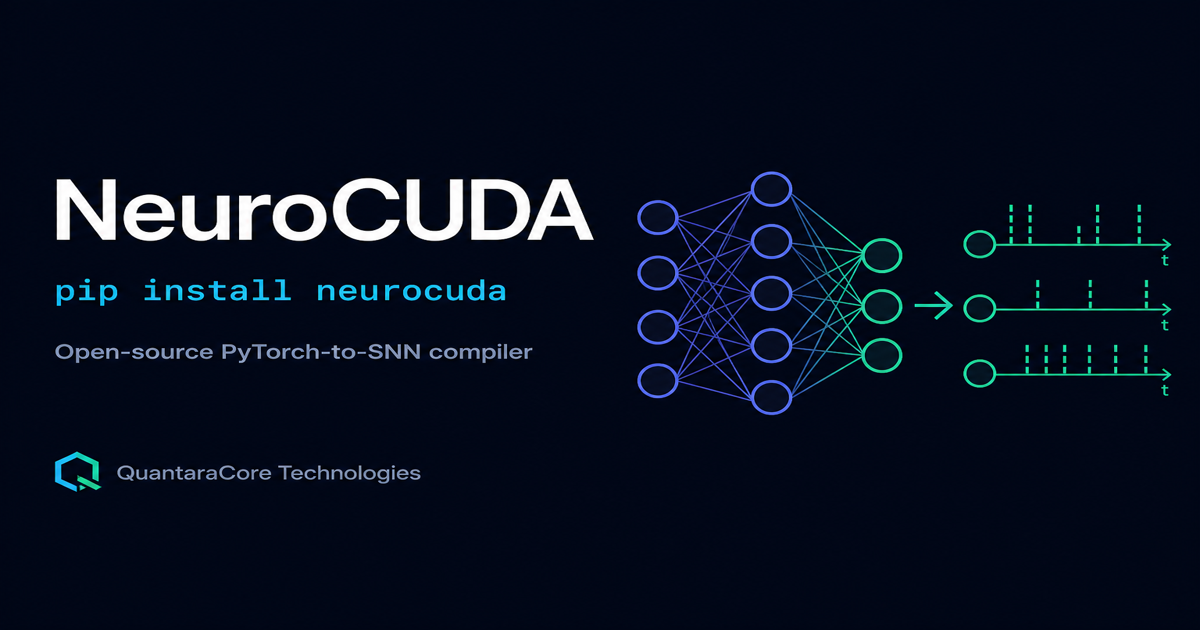
Search results for neurocuda vs spikingjelly often flatten both names into one bucket labeled "PyTorch SNN library." That bucket is wrong. SpikingJelly is built so you can write spiking layers, loop over timesteps, apply surrogate gradients, and train a network that was spiking from epoch one. NeuroCUDA is built so you can keep a conventional ReLU network you already trained, calibrate it, replace activations with integrate-and-fire neurons, and fine-tune the result. The first tool answers "how do I train spikes." The second answers "how do I convert this checkpoint."
QuantaraCore Technologies LLP builds NeuroCUDA and documents SpikingJelly fairly because picking the wrong tool costs weeks. This article is the pairwise decision page: jobs, APIs, CUDA meaning, ResNet handling, event data, backends, and honest limits. Author: Krishna Santosh Varma. Source for NeuroCUDA: github.com/Krishnav1/neurocuda. Product hub: /neurocuda. Technical report: /neurocuda/paper.pdf.
NeuroCUDA vs SpikingJelly: two different jobs
The useful way to read neurocuda vs spikingjelly is to ask what you already have on disk. If the answer is a trained torch.nn.Module with ReLU activations, you do not want to throw away GPU hours and rebuild every layer as a spiking module. If the answer is a research question about neuron models, surrogate functions, or training a spiking architecture from random weights, you do not want a converter that assumes the hard ANN training is finished.
| Dimension | SpikingJelly | NeuroCUDA |
|---|---|---|
| Primary job | Train SNNs from scratch | Convert trained ANN to SNN |
| Starting input | Spiking layer definitions | Pretrained PyTorch checkpoint |
| Core method | Surrogate gradient BPTT | QCFS calibration + BPTT fine-tune |
| Typical user | Researcher designing SNNs | ML engineer with production ANN |
| License | Open source (project license) | MIT |
| Install | pip install spikingjelly | pip install neurocuda |
| Source | github.com/fangwei123456/spikingjelly | github.com/Krishnav1/neurocuda |
That table is the entire comparison if you already know your starting artifact. The rest of this page exists because forums still treat the two names as interchangeable CUDA SNN stacks. They share PyTorch and they share the word "spike." They do not share a pipeline.
What SpikingJelly actually is
SpikingJelly is a PyTorch SNN training library. You define neurons (LIF, IF, and related variants), wrap them in sequential or residual modules, and train with surrogate gradients so the non-differentiable spike can still receive a gradient. The library emphasizes computational efficiency: CUDA-accelerated neuron simulation, cupy paths, and multi-step modules that keep the timestep loop inside fused kernels instead of a slow Python for t in range(T) around every layer.
A typical SpikingJelly workflow looks like architecture design, not conversion. You choose a neuron, a surrogate (atan, sigmoid, or a custom function), a timestep count, a reset mode, and a loss that reads either spike counts or membrane potentials at the last layer. You then train for tens or hundreds of epochs on GPU, watching accuracy climb from random initialization the same way you would train a CNN, except every forward pass is a sequence of binary events.
import torch
import torch.nn as nn
from spikingjelly.activation_based import neuron, functional, layer, surrogate

class SJNet(nn.Module):
    def __init__(self):
        super().__init__()
        self.conv = layer.Conv2d(2, 32, kernel_size=3, padding=1)
        self.bn = layer.BatchNorm2d(32)
        self.lif = neuron.LIFNode(surrogate_function=surrogate.ATan())
        self.pool = layer.AdaptiveAvgPool2d(1)
        self.fc = layer.Linear(32, 10)

    def forward(self, x):
        # x: [N, T, C, H, W] event tensor, not a CIFAR RGB frame
        x = self.lif(self.bn(self.conv(x)))
        x = self.pool(x).flatten(1)
        return self.fc(x)

net = SJNet()
functional.reset_net(net)  # required between samples in many SJ setups
That sketch is teaching code, not a claim that one tutorial net matches a published leaderboard. The point is the job: you own the spiking architecture. SpikingJelly will not ingest a ResNet-18 ANN checkpoint, fold BatchNorm, calibrate ReLU thresholds, and emit a validated SNN. If that is what you need, you are in NeuroCUDA territory.
What NeuroCUDA actually is
NeuroCUDA is a conversion compiler. The hard ANN training is assumed done. You load a ReLU torch.nn.Module, pass a calibration DataLoader that looks like deployment data, and call convert. Inside that call, QCFS (quantization-clip-floor-shift) replaces ReLU with a calibrated, still-graded activation; BatchNorm folds into preceding conv or linear weights; integrate-and-fire neurons replace the calibrated activations; BPTT fine-tuning with an atan surrogate recovers accuracy that a naive ReLU-to-spike swap would destroy.
import neurocuda

# pip install neurocuda
# source: https://github.com/Krishnav1/neurocuda
snn, meta = neurocuda.convert(model, calib_loader)
neurocuda.compile(snn, target="gpu")
acc = neurocuda.evaluate(snn, test_loader)
sparsity = neurocuda.measure_sparsity(snn, test_loader)
neurocuda.to_nir(snn, "converted.nir")
Published, multi-seed numbers live in the technical report. On a 3-layer CNN for N-MNIST (event-based, not CIFAR images): SNN 99.88% ± 0.02% versus ANN 99.70%. On ResNet-18 / CIFAR-10 at T=32: SNN 94.61% ± 0.14% versus ANN 95.56% ± 0.11%. GPU versus CPU spike match: 0 deviations across 256,000 comparisons. NIR residual round-trip on ResNet-18: 0.000000 max absolute difference. Those figures are conversion evidence, not from-scratch SNN training evidence. Do not paste them into a SpikingJelly paper as if the training library produced them.
Head-to-head feature table
| Feature | SpikingJelly | NeuroCUDA |
|---|---|---|
| ANN-to-SNN conversion | Not the primary design | Core purpose (QCFS + BPTT) |
| From-scratch SNN training | Core purpose | Not the product job |
| Surrogate gradients | First-class, many variants | Used inside BPTT fine-tune |
| ResNet from ANN checkpoint | Rebuild + retrain as SNN | Direct convert, 94.61% published |
| N-MNIST event path | Train on event tensors | Convert ANN; 99.88% published |
| NIR export | Via ecosystem tools if at all | Built-in, residual verified |
| Loihi 2 | No first-class backend | IF-neuron simulator only |
| SpiNNaker | Not this library's job | Physical silicon smoke test, not N-MNIST on chip |
| CUDA role | Fused neuron training kernels | GPU inference / conversion backend |
| GPU/CPU spike parity tests | User responsibility | Published 256k spike check |
Read the CUDA row twice. SpikingJelly's CUDA story is "make training large SNNs fast." NeuroCUDA's CUDA story is "run the converted network on GPU and prove it matches CPU." Both are neuromorphic CUDA in the loose sense used by the neuromorphic CUDA field guide. They are not the same kernel generator, and neither is NVIDIA cuDNN.
Workflows compared in code
SpikingJelly: train from scratch
You allocate a spiking net, reset state between samples, accumulate loss over T steps, and step an optimizer. Data is often already in a timestep-major layout. For event cameras that can be natural. For CIFAR RGB it means encoding pixels into spikes first, which is a separate design choice and a common source of "why is my accuracy 20%" bugs.
# Conceptual SpikingJelly training loop
for images, labels in train_loader:
    functional.reset_net(net)
    optimizer.zero_grad()
    out = net(images)          # images already [N, T, ...]
    loss = criterion(out, labels)
    loss.backward()
    optimizer.step()
NeuroCUDA: convert a trained ANN
You keep the ANN training loop you already trust. Conversion is a compiler pass plus a short BPTT fine-tune, not a from-scratch run to 200 epochs of spiking layers. Calibration data must match test preprocessing. Then you compile a backend and evaluate against the same test set you used for the ANN baseline.
import torch, neurocuda

model.eval()
snn, meta = neurocuda.convert(model, calib_loader, timesteps=32)
neurocuda.compile(snn, target="gpu")
ann_acc = neurocuda.evaluate(model, test_loader)
snn_acc = neurocuda.evaluate(snn, test_loader)
print(ann_acc, snn_acc, meta)
The meta object is conversion metadata (thresholds, timestep settings, calibration notes). Keep it next to the checkpoint so a later engineer can reproduce the run. For a command-level reproduction path see reproduce NeuroCUDA results. For a free GPU notebook path see NeuroCUDA on Google Colab.
When SpikingJelly wins
- You do not have a trained ANN, or the ANN is a throwaway baseline you would retrain anyway.
- The architecture is spiking-native: custom LIF parameters, recurrent SNN cells, or research into surrogate functions.
- You need fused CUDA neuron kernels because the timestep loop is the bottleneck, not conversion accuracy.
- You are teaching or learning membrane dynamics, reset modes, and spike-count losses.
- Event-camera research where the network should be spikes all the way through training, not an ANN trained on voxel grids then converted.
Those are real jobs. NeuroCUDA will not replace a research simulator or a from-scratch training library. Claiming otherwise would be the same category error this page exists to stop.
When NeuroCUDA wins
- You have a production PyTorch perception model (robotics, edge vision, event-camera ANN trained on accumulated frames or voxel grids).
- Stakeholders need published conversion gaps, not a new from-scratch SNN paper.
- Residual architectures must convert without manual skip-connection surgery. See ResNet-18 SNN conversion tutorial for the CIFAR path, which is a different tutorial from N-MNIST.
- You need NIR export with a verified residual executor. See export PyTorch to NIR.
- You want GPU today, CPU CI parity, and a Loihi 2 equation simulator without Intel Lava. Loihi 2 remains a simulator. Physical Loihi silicon is not claimed.
Install remains one line: pip install neurocuda. Optional extras: pip install neurocuda[all]. Method explainer for the calibration stage: QCFS ANN to SNN. If thresholds stall during conversion, that is a debugging article (QCFS threshold not learning), not a reason to switch to SpikingJelly.
Accuracy: do not mix leaderboards
Comparing a SpikingJelly MNIST tutorial to NeuroCUDA ResNet-18 CIFAR numbers is not a comparison. One is from-scratch training on a task the author chose. The other is a conversion gap versus a fixed ANN baseline, multi-seed, full test set. The fair neurocuda vs spikingjelly question is workflow fit.
| Evidence type | SpikingJelly papers / tutorials | NeuroCUDA report |
|---|---|---|
| What is measured | SNN trained from init on a task | Converted SNN vs same ANN |
| N-MNIST 99.88% | Not this compiler's number | Yes: SNN 99.88% ± 0.02% vs ANN 99.70% |
| ResNet-18 CIFAR 94.61% | Would require a from-scratch SNN ResNet | Yes: T=32 conversion, 0.95 pp gap |
| How to cite | Cite the SpikingJelly paper you actually ran | Cite paper.pdf and the GitHub repo |
N-MNIST is event-based neuromorphic MNIST, recorded with a DVS camera. It is not CIFAR-10 RGB. Mixing those datasets is the second most common error after mixing the tools. Dedicated event conversion write-up: N-MNIST SNN conversion. Event-camera ROS2 context: event camera DVS ROS2.
Residual networks and skip connections
Skip connections are where converters fail silently. Two branches must sum at the merge node in the same order the ANN did. SpikingJelly can implement residual SNNs if you write them. That is architecture work. NeuroCUDA's contribution is narrower: convert a trained ResNet-18, keep residual adds, export NIR, and verify bit-exact round-trip on that residual graph. If your question is "can I train a residual SNN from scratch with CUDA kernels," SpikingJelly is in play. If your question is "can I convert this ResNet-18.pth," NeuroCUDA is the direct path.
Backends and hardware honesty
SpikingJelly targets GPU and CPU training and inference in PyTorch. That is appropriate for a training library. NeuroCUDA labels backends as follows, and this page will not inflate them:
- NVIDIA GPU: conversion and inference backend with published accuracy.
- CPU: bit-exact to GPU in the published spike check. Useful for CI.
- Loihi 2: IF-neuron simulator checked against published equations. Not Loihi silicon. Not Lava.
- SpiNNaker-1: physical silicon smoke test on EBRAINS (jobs documented on the silicon post). That smoke test is not N-MNIST accuracy on chip and is not a SpikingJelly backend.
- NIR: portable graph, not a chip.
If a vendor page tells you SpikingJelly "deploys to Loihi" or NeuroCUDA "matches SpiNNaker ResNet accuracy," demand the job ID and the test set. Until then, use the labels above. Broader compiler landscape: ANN to SNN conversion tools compared.
Can you use both?
Yes. A sane hybrid looks like this:
- Prototype neuron behavior, reset semantics, and timestep counts in SpikingJelly on a small event or MNIST-scale task.
- Train the production ANN in vanilla PyTorch so you can use standard augmentations, AMP, and the rest of your ML stack.
- Convert with NeuroCUDA:
snn, meta = neurocuda.convert(model, calib_loader). - Validate on GPU, measure sparsity, export NIR if you need a vendor-neutral graph.
That sequence respects each tool. It also avoids the failure mode where a team spends a quarter rewriting ResNet in spiking layers because a listicle said SpikingJelly is "the CUDA SNN framework" and never mentioned conversion.
Common mistakes when people search this pair
- Treating them as snnTorch clones of each other. snnTorch is a third library. Pairwise page: snnTorch vs NeuroCUDA. This page stays on SpikingJelly.
- Expecting convert() in SpikingJelly. You will write neurons and train. That is the product.
- Expecting from-scratch SNN research APIs in NeuroCUDA. You will convert. Custom plasticity belongs elsewhere.
- Pasting CIFAR numbers onto N-MNIST or the reverse. Different datasets, different tutorials.
- Calling Loihi 2 "on chip" because a simulator compiled. Simulator only.
- Calling SpiNNaker smoke tests an N-MNIST result. They are not.
Decision table you can hand to a teammate
| If you have this | Start here |
|---|---|
| Trained ReLU PyTorch CNN / ResNet | NeuroCUDA convert HowTo |
| Need to learn LIF / surrogate math | SpikingJelly tutorials |
| Event-based N-MNIST conversion numbers | N-MNIST SNN conversion page |
| CIFAR-10 residual conversion | ResNet-18 SNN conversion tutorial |
| Need NIR file from a checkpoint | Export PyTorch to NIR |
| Need neuroscience simulators, not ML converters | NeuroCUDA vs GeNN vs Brian2 |
GeNN and Brian2 are simulators, not SNN training libraries in the SpikingJelly sense and not converters in the NeuroCUDA sense. If that is your search, go to NeuroCUDA vs GeNN vs Brian2 instead of this page.
Primary sources
- NeuroCUDA GitHub (MIT), github.com/Krishnav1/neurocuda
- NeuroCUDA technical report, quantaracore.in/neurocuda/paper.pdf
- NeuroCUDA product hub, quantaracore.in/neurocuda
- SpikingJelly repository, github.com/fangwei123456/spikingjelly
- ANN-to-SNN tools compared, quantaracore.in/blog/ann-to-snn-conversion-tools-compared
- Convert PyTorch to SNN, quantaracore.in/blog/convert-pytorch-to-snn
Frequently asked questions
What is the difference in NeuroCUDA vs SpikingJelly?
NeuroCUDA is an ANN-to-SNN conversion compiler. You start with a trained PyTorch checkpoint, run pip install neurocuda, and call snn, meta = neurocuda.convert(model, calib_loader). SpikingJelly is a PyTorch SNN training library: you define spiking layers and train from scratch with surrogate gradients. They solve different jobs.
Is NeuroCUDA better than SpikingJelly?
Neither is universally better. NeuroCUDA is better when you already have a trained ReLU ANN and need a validated spiking network with published accuracy, NIR export, and GPU/CPU backends. SpikingJelly is better when you want to design and train an SNN from random initialization with CUDA-accelerated neuron kernels.
Does SpikingJelly convert a trained PyTorch ANN?
Conversion of a finished ANN checkpoint is not SpikingJelly's primary job. SpikingJelly trains SNNs from scratch with surrogate gradients. For conversion, use NeuroCUDA: pip install neurocuda, then neurocuda.convert(model, calib_loader). Source: github.com/Krishnav1/neurocuda.
Can I use NeuroCUDA and SpikingJelly together?
Yes. A common pattern is to learn neuron dynamics and timestep loops in SpikingJelly on a small task, then train a production ANN in standard PyTorch and convert it with NeuroCUDA for GPU validation, NIR export, and published conversion accuracy.
How do I install NeuroCUDA for this comparison?
Run pip install neurocuda (or pip install neurocuda[all] for extra backends). The project is MIT licensed at github.com/Krishnav1/neurocuda. SpikingJelly is installed separately with pip install spikingjelly.
Does NeuroCUDA vs SpikingJelly matter for ResNet?
Yes. If you have a trained ResNet-18 checkpoint, NeuroCUDA converts it with published CIFAR-10 SNN accuracy of 94.61% at T=32 and bit-exact residual NIR export. SpikingJelly can train ResNet-style SNNs from scratch, which means rebuilding layers and retraining, not loading the ANN weights. CIFAR walkthrough: ResNet-18 tutorial.
Which tool is better for N-MNIST?
If you already trained an ANN on N-MNIST event tensors, NeuroCUDA conversion reports 99.88% ± 0.02% SNN versus 99.70% ANN. If you want to train a spiking network on events from scratch, SpikingJelly is a training library for that workflow. See N-MNIST SNN conversion for the event-dataset path.
Is this the same as snnTorch vs NeuroCUDA?
No. snnTorch is a different PyTorch SNN training library. This page is SpikingJelly specifically. The snnTorch comparison lives at /blog/snntorch-vs-neurocuda and should not be treated as a duplicate of this URL.
Does NeuroCUDA run on Loihi 2 or SpiNNaker?
Loihi 2 in NeuroCUDA is a simulator of IF-neuron equations, not physical Loihi silicon. SpiNNaker-1 physical silicon is a smoke test of spike delivery on EBRAINS boards, not a claim that SpikingJelly models or N-MNIST accuracy ran on chip. SpikingJelly targets GPU/CPU training, not those backends.
Where is the NeuroCUDA source and paper?
Source is https://github.com/Krishnav1/neurocuda under the MIT license. The technical report is https://quantaracore.in/neurocuda/paper.pdf. Product hub: https://quantaracore.in/neurocuda. Install with pip install neurocuda.
Start now: pip install neurocuda · Product page · PDF report · GitHub